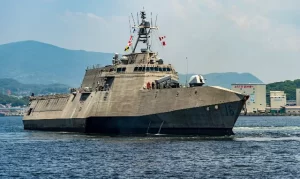
The Independence-class littoral combat ship USS Tulsa prepares to moor in Sasebo Japan. US Navy photo
USNI News : US Navy Won’t Decommission More Littoral Combat Ships, Officials Say.
ARLINGTON, Va. — The surface force will net a total of seven Littoral Combat Ships after the Navy shelved plans to decommission the hulls ahead of their expected service lives, USNI News has learned. Service officials speaking earlier this month at the Surface Navy Association said the Navy had reversed plans to decommission five Freedom-class and two Independence-class LCS.
Acting LCS program manager Jay Iungerich told USNI News his office wasn’t planning on moving ahead with decommissioning the seven ships, taking their cues from the larger Navy. “No signals right now,” Iungerich said. “More ships, right? Retaining the seven ships (which had been scheduled for early decommissioning) will leave the Navy with 28 small surface combatants.
Surface Forces commander Vice Adm. Brendan McLane told USNI News in a short interview during the conference the service was pleased with the three ship Independence-class performance mine countermeasure missions in U.S. 5th Fleet. The MCM mission for LCS was the most complex of three mission packages that were initially developed for the ships that would hunt for and destroy sea mines. After more than a decade of stops and starts, the sea service deployed the first completed package to the U.S. base in Bahrain last year aboard three Independence-class LCS — USS Canberra (LCS-30), USS Tulsa (LCS-16) and USS Santa Barbara (LCS-32). Four of the MCM mission packages have been delivered to the Navy with the next three mission packages set to deliver later this year, George Saroch, the acting program manager for the LCS mission modules said at SNA.
With the departure of the Avengers from Bahrain, the last four deployed MCMs are at the U.S. base at Sasebo, Japan, and are set to be replaced by Independence-class LCS. In addition to the MCM package, LCS field a surface warfare mission package that includes the Naval Strike Missile, 30 mm guns and a module that fires AGM-114L Hellfire missiles. LCS was also pushed as a platform for testing other systems that add to the lethality of the ships, the Navy has said. The Navy has tested the Lockheed Martin MK 70 Typhoon missile launcher capable of firing both Standard Missile 6s and Tomahawk Land Attack Missiles using a virtualized Aegis Combat System and an air search radar system.
Part of the justification for keeping the LCS is tied to the emerging robotic autonomous systems, the Navy’s current term for unmanned systems. LCS has become a test bed for RAS support with both Freedom and Independence classes of ships. “That mission bay was always — particularly in the Indy — such a great and strength,” McLane told USNI News. “You can put all kinds of stuff in there.” In particular, LCS has tested the Textron fixed-wing Aerosonde unmanned aerial system and the Black Sea Global Autonomous Reconnaissance Craft small unmanned surface vessel. “We have been integrating launch recovery and integrating small USVs from both the Indy and the Freedom variants,” Saroch said. “That work continues forward. There’s obviously a lot of interest in bringing that capability further into fleet.” Source: USNI News 27/01