DEFENCE CONNECT : Mitsubishi taps Raytheon to provide SeaRAM CIWS for Australia’s future Mogami frigates, 12 May 2026, By: Stephen Kuper
Raytheon has been awarded a contract by Mitsubishi Heavy Industries to provide SeaRAM ship self-defense systems for the Royal Australian Navy’s Sea3000 General Purpose Frigate program. The program will replace the Anzac-class frigates with 11 upgraded Mogami-class frigates. Under the contract, Raytheon will provide SeaRAM launchers, Blast Test Vehicles, and technical services supporting installation and testing for the program’s first three ships being built in Japan.
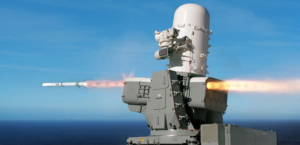
SeaRAM system
Raytheon has been selected to provide the Royal Australian Navy’s future general purpose frigate fleet with the advanced SeaRAM close-in air and missile defence system, marking Australia’s first acquisition of the combat-proven capability. The contract, awarded by Japanese shipbuilder Mitsubishi Heavy Industries, will support the first three vessels under Australia’s SEA 3000 General Purpose Frigate program, which will see the Navy field an evolved version of Japan’s Mogami Class frigate as the replacement for the ageing Anzac Class fleet.
Under the agreement, Raytheon will deliver SeaRAM launchers, blast test vehicles and associated technical support services to enable installation and integration aboard the first batch of ships, which are set to be constructed in Japan before production transitions to Australia later in the program. Raytheon said the selection represented a major enhancement in the survivability and layered defensive capability of Australia’s future surface fleet. “SeaRAM extends the defensive reach of a ship beyond traditional close-in weapon system ranges.”
“By integrating SeaRAM on the Royal Australian Navy’s new surface combatants, Australia gains a proven, highly effective terminal air and missile defence layer for its future fleet.”
The system combines the sensors and autonomous tracking architecture of the Phalanx Close-In Weapon System (CIWS) with the Rolling Airframe Missile (RAM), creating a rapid-reaction point defence capability designed to intercept anti-ship cruise missiles, loitering munitions, helicopters, aircraft and increasingly sophisticated airborne threats during the final stages of an engagement.
Unlike conventional gun-based CIWS systems, SeaRAM uses an 11-cell launcher armed with RAM interceptors, significantly increasing engagement range and lethality against modern sea-skimming missile threats while reducing the risk of debris and collateral damage associated with high-volume naval gunfire.
The Royal Australian Navy’s adoption of SeaRAM also positions Australia within the growing international RAM user community, which includes the United States, Japan, Germany, South Korea, Greece, Egypt, Qatar, Turkey, Saudi Arabia and the United Arab Emirates.