T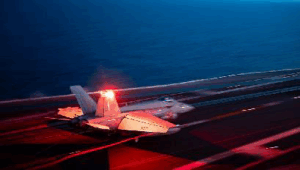 he United States is building up its military presence near Iran as tensions with Israel continue to rise, with multiple carrier strike groups and a growing array of supporting assets converging in the region.
The USS Nimitz, one of the U.S. Navy’s nuclear-powered aircraft carriers, is now en route from the South China Sea to the Arabian Sea. Accompanied by its full complement of aircraft and escorted by five guided-missile destroyers, the Nimitz is joining the USS Carl Vinson strike group, which is already deployed near the Middle East. This dual-carrier deployment marks a significant show of force as Washington seeks to deter further escalation amid fears of a broader regional conflict between Iran and Israel.
The redeployment of the Nimitz, confirmed by multiple U.S. media reports, comes alongside an unprecedented surge in aerial refuelling activity across the Atlantic. In the past 48 hours, at least two dozen U.S. Air Force aerial refuelling tankers—KC-135s and KC-46s—have flown eastward from the continental United States. While the exact purpose of the tanker surge remains unconfirmed, the scale and timing of the movement are highly unusual and appear linked to preparations for sustained air operations in the Middle East.
The mobilisation follows the earlier repositioning of two U.S. Navy destroyers from the Mediterranean to waters closer to Israel and the deployment of U.S. Army THAAD air defence systems. Together, these moves reflect a coordinated buildup of American firepower in response to growing concerns that Israel and Iran could soon enter open conflict, drawing in regional and global actors. While the Pentagon has not confirmed intentions for direct intervention, the deployment of multiple carrier strike groups and tanker support assets gives the U.S. considerable flexibility to project air power, conduct long-range strikes, or support allied operations if required.
The Nimitz-class aircraft carriers are among the largest warships in the world, with a full-load displacement of over 100,000 tons. Measuring approximately 332.8 metres in length with a beam of 76.8 metres at the flight deck, these nuclear-powered vessels are designed to operate for over 20 years without refuelling. Each ship is propelled by two nuclear reactors driving four propeller shafts, enabling speeds in excess of 30 knots and virtually unlimited range. The class includes a complement of more than 5,000 personnel, including ship’s company and embarked air wing. The carriers are equipped with four catapults and four arresting gear cables, allowing them to launch and recover fixed-wing aircraft at a high sortie rate. The flight deck supports simultaneous take-off and landing operations, typically handling over 80 aircraft during full operations. Defensive systems include the NATO Sea Sparrow Missile System, Rolling Airframe Missiles (RAM), and Phalanx CIWS for close-in threats. Upgrades to command and control, electronic warfare, and radar systems have kept the class relevant through successive refits.
Embarked air wings aboard Nimitz-class carriers are composed of a range of aircraft, primarily centred around the F/A-18 Hornet and Super Hornet multi-role fighters. These aircraft perform strike, air superiority, close air support, and suppression of enemy air defences. Other aircraft typically include the E-2D Hawkeye for airborne early warning, EA-18G Growler for electronic warfare, and MH-60 Seahawk helicopters for anti-submarine warfare and utility tasks. The F/A-18E/F Super Hornet, the primary strike aircraft aboard the Nimitz-class, has a combat radius of over 390 nautical miles and can carry up to 17,750 pounds of ordnance. It is powered by two General Electric F414-GE-400 engines, providing a maximum speed of Mach 1.6. The aircraft features advanced avionics, radar, and targeting systems, with capabilities to employ precision-guided munitions, air-to-air missiles, and anti-ship weapons, making it a versatile platform in both offensive and defensive roles. Source: UK Defence Journal 17/06