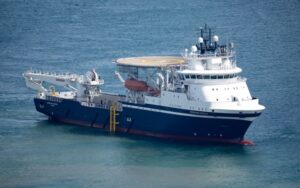
RFA Stirling Castle of the Royal Fleet Auxiliary has now become HMS Stirling Castle of the Royal Navy
Earlier this week RFA Stirling Castle, which belonged to the Royal Fleet Auxiliary (RFA), became HMS Stirling Castle of the Royal Navy. This is not the first time this has happened in the two services’ history, but it’s rare. It also has a significance that goes beyond the abbreviation reshuffle.
The first and most obvious thing to note is that this change has come about because the RFA – the civilian-manned flotilla which provides auxiliary vessels to support the RN – has found itself unable to crew the Stirling Castle. This reflects the parlous condition of the RFA. Of the 11 ships currently belonging to that service, around four can actually put to sea. The only Fleet Solid Support ship we have – RFA Fort Victoria – is alongside with no known repair timeline. As a Carrier Strike Group without a solid support ship is semi-crippled, our carrier HMS Prince of Wales, deployed at the moment to the Pacific, is getting that vital support from a Norwegian vessel.
Will Fort Victoria ever return to service? Well, she “could be saved with very deep pockets” was the word from someone serving.
Another vital vessel is RFA Argus, which fulfils two important functions. As essentially a small helicopter carrier, she can be used for flight training or as a seagoing base for helicopters. She also has a 100-bed medical complex aboard, and is our best option as a casualty receiving ship. That’s a hospital ship, in other words, but designated hospital ships are subject to various restrictions and requirements under the laws of war so we do not declare her as one. Argus is now in such a state that special dispensation was required for her to move berths in Portsmouth Harbour, much less sail her to somewhere she can be repaired.
Meanwhile, RFA sailors and officers have been working hard but don’t feel their pay reflects that. Some have gone on strike, many have left – unlike Royal Navy personnel they have recognised civilian qualifications and there is a worldwide shortage of mariners with good jobs easily found. Another issue is that many are fed up with being regarded as second fiddle to the RN, especially as the RN has taken to handing over front line combat jobs such as mine clearance and amphibious assault to the RFA. Against that backdrop, you can see why reducing the overall number of ships to 10 helps. Stirling Castle was built to run with a ship’s company of 30, so you would think it might not matter, but that’s one less captain with a master’s ticket to find, and one less chief engineer – it’s such specialist people who are in crucially short supply.
Stirling Castle was purchased in 2023 to support the Royal Navy’s mine countermeasure operations. The RN’s remaining Hunt and Sandownclass minehunters are now very old and the prospect of replacing them was giving the Treasury a headache. The thinking was that RFA mother ships deploying the latest uncrewed minehunting and disposal platforms into the minefield is a better and safer option than sending in manned minehunters to clear their way through. If you stand far enough back from the problem and look at it through Treasury lenses that enable you to ignore all the other tasks minehunters can do apart from minehunting, this could one day prove to be correct. It does, however, need both your unmanned solution and your mother ship to be ready on time or you will have a capability gap. This is where we are today.
Interestingly the Dutch and the Belgian navies collaborated on this and although their “mother ship-plus-drones” solution is broadly similar to ours and the French, they have built more of them and they look like small warships, i.e. they were not bought in from merchant service and they have some weapons. This is an important point.
The Royal Navy has operated non-military vessels on and off over the years, including an RFA to HMS conversion during the Falklands campaign, but often does not do it well. It’s not surprising really when you consider the many systems and organisations in the RN have been shaped over decades to operate complex warships conforming to naval design criteria. If you then inject a ship of a different type – i.e. commercial build – that organisation can be slow to adjust: painfully slow, sometimes.
Our ice vessel HMS Protector operated flawlessly for over seven years as MV Polar Björn but since we took her over, has had endless reliability problems. The story is liable to pan out the same way with RFA Stirling Castle, formerly MV Island Crown. In this case the RN will take away Uncrewed Machinery Spaces (UMS) and put people in the engine rooms. The ship was not designed to run this way – it’s a warship and fighting way of thinking. Stirling Castle has a high degree of redundancy built in and if systems fail, they will switch to alternatives automatically.
But the RN’s Flag Officer Sea Training team down at Plymouth, internationally renowned for putting warships through their paces prior to deploying, are not fans of automated systems – they want to see things done the old-fashioned way. Turning equipment on and off for training purposes caused a converted merchant ship I once commanded, HMS Endurance, to repeatedly lose propulsion at sea. It took an engineer from the Norwegian build company to visit and ask what on earth we thought we were doing for us to stop. Old habits die hard.
When it comes to Stirling Castle herself, we have bought a solid platform here that worked well as a merchant vessel. Some think it needs a bigger external and internal working space to be truly effective as a mother ship but more immediate is that her conversion to minehunting duties by the RFA has been troubled and we are now asking the RN, who find this equally hard, to sort her out. In other words, we are some way from making this ship into a durable, survivable and operationally effective mine hunting host ship. That doesn’t mean it won’t work, but care, and money, are now required.
There are also two broader questions that this transfer raises. Both can be considered controversial. First, what does this mean to the overall future of the RFA and second, is taking ships up from trade in this manner actually the future for the RN?
The future of the RFA is one of those problems where it’s tempting to go “full disruptor” and with a sweeping hand, order it to merge once and for all with the RN. As ever, the reality is not that simple. It would likely reignite the exodus of RFA sailors, many of whom joined that service and not the RN for a reason. Bridge and engineering qualifications between the two services do not align although that could probably be mitigated over time.
How this plays out depends on what becomes of the two major build programs that the RFA has coming up. The first is a class of three replacement Fleet Solid Support Ships to replace the aged Fort Vic. This plan has suffered much delay and political wrangling, but it is at least costed. The second is the Multi-Role Support Ship, a vessel that the future of the Royal Marines and their ability to move from sea to shore depends upon. At present, these crucial vessels are nothing more than a few lines in the Strategic Defence Review (SDR) and the odd design sketch. Currently, the RFA has one working amphibious ship, the RN has zero.
Could the RN take back the amphibious mission and the minehunting motherships, leaving the RFA to run the tankers and support ships? This seems like a natural division of labour but would need firm leadership to force it through and even then the RN is short of people too. At least that problem is not as severe as it is for the RFA. The recent Strategic Defence Review mentions some of this but offers no detail – especially on money. The Investment Plan, due in the Autumn, will have some serious questions to answer here, as with everything all across Defence.
The other even broader question is to what level should the Stirling Castle model of simply putting combat equipment on affordable merchant service hulls be used. Here the answer is divided between traditionalists and realists. The traditionalist view is that a warship should be a purpose-built thoroughbred, sleek, as fast as possible, bristling with weapons and sensors and made to exacting standards in order to be survivable in war.
There are others of my acquaintance who would suggest that (for example) three Merlin anti-submarine helicopters on an ex-merchant hull would fight submarines at least as well as a single Merlin on a frigate. They’d suggest that radar drones or helicopters would find enemy surface units or aircraft much further away than a destroyer’s radar can, being up in the air with hugely greater line of sight. They’d point out that destroyer weapons are already supplied in containerised forms suitable for bolting on to any hull. These people point out that a dedicated warship’s high top speed – typically achieved using expensive gas turbines – is usually irrelevant as the thirsty gassers get through fuel very quickly at speed. A warship cannot actually travel over any serious distance any faster than its accompanying auxiliary tanker. When high speed is called for in combat, aircraft or missiles are what count: a frigate’s primary means of attacking submarines is, after all, its helicopter.
But I’m a former frigate captain and a specialist in the use of destroyers, and I’d rather have frigates and destroyers. There is a reason frigates, destroyers, aircraft carriers, nuclear submarines etc have remained largely unchanged in recent decades – they work. But I would freely admit that an insistence on exquisite, fast, heavily equipped specialist warships has got us to a terrible place in terms of capabilities and numbers. I do wonder how we punch our way out of the navy-wide hole we are currently in when there is no more serious money coming. I do ask how we achieve the mass that is missing and uncrewed advancement that we so obviously need? Before long every platform starts looking like a Stirling Castle-type purchase, or container ships with drones the way the Iranians are doing it, or uncrewed surface weapons and expensive proper warships are consigned to the military history bin.
As ever, the answer is probably somewhere in the middle, but this is a balance that is hard to strike when financial conditions constantly force you to make decisions because you have to, not because you should. In the meantime, it’s a safe bet that the practice of converting unusual ships for RN use is going to increase. So let’s use the transfer of Stirling Castleto the Royal Navy as a test bed to become better at it.
Tom Sharpe is a former Royal Navy officer who commanded four different warships including the frigate HMS St Albans and the ex-merchant icebreaker HMS Endurance. He was an anti-air warfare specialist by training