Navy Lookout : In the first major naval announcement of the Strategic Defence Review, the (UK) Prime Minister has promised to construct up to 12 SSNs (nuclear-powered attack submarines) to replace the Royal Navy’s 7 Astute class boats from the late 2030s.
This aspiration is undoubtedly very good news and is absolutely the correct choice for the priority investment in naval power, provided these submarines can be delivered. Despite developments in UUVs and underwater sensing, the SSN remains the apex naval predator and will continue to be the key naval platform for decades to come. Although not a panacea, in preparing for potential conflict with other states, SSNs are arguably the most important conventional assets the UK can deploy.
Submarines are a force multiplier and can be used to create the conditions necessary for sea control, allowing other forces to be effectively employed. The mere threat of a submarine will influence the actions of an adversary and they are a powerful deterrent. In a full-scale conflict spanning oceans, they are the best means to destroy ships and other submarines and if well handled, are very hard to detect and counter. Submarines can enforce a blockade for sustained periods, denying the enemy supplies and strangling trade. A genuine submarine threat is generally going to be the biggest single headache for any naval task force commander.
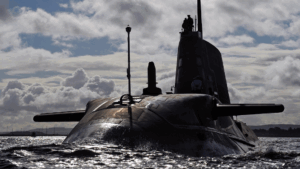
RN Astute class – SSN-AUKUS starting concept
The new generation of SSN-AUKUS will be equipped with submarine-launched cruise missiles (SLCM) which provide a stealthy way to deliver precision strikes inland. The submarine’s ability to penetrate so-called ‘anti-access and area denial (A2AD) bubbles’, which have become too dangerous for the surface fleet is perhaps one of the areas where its advantage has increased most. The submarine can also stealthy insert Special Forces onto coastlines and in peacetime or lower-intensity scenarios, is the ultimate intelligence gathering platform that can listen, shadow and record the actions of adversaries.
The MoD says: “the boost to the SSN-AUKUS programme will see a major expansion of industrial capability at Barrow and Raynesway, Derby, with the build of a new submarine every 18 months in the future.” The current SSN delivery programme and force posture does not inspire great confidence. There are currently six Astute-class SSNs in commission. On a good day, two of these boats might be at sea, although there have been periods in recent years when the RN was unable to deploy even a single SSN. Of the 6 in commission, two boats, HMS Ambush and HMS Artful, have not sailed on operations for almost 3 years. HMS Audacious spent 18 months waiting for a dry dock to become available in Devonport before hull repairs could begin.
The original design of the Astute-class boats did not pay enough attention to through-life support, which has made them difficult to maintain in service. It must be assumed that SSN-AUKUS will address this issue that has been a serious contributing factor to unavailability.
The Astute construction project has been colossally drawn out and over-budget. The 7th boat is still some way from becoming operational 16 years after boat 1 commissioned. The underlying causes have been addressed to some extent and the design and build capability that had been allowed to dissipate in the late 1990s has been regenerated. The experienced workforce and infrastructure that is being built up for the Dreadnought SSBN project should enable SSN-AUKUS to be delivered far more efficiently than the Astutes. A ‘hot production line’ will enable faster delivery but the Astutes have taken an average of about 10 years/120 months from laying down to commissioning and Dreadnought will probably take around 7-8 years. Accelerating the pace of delivery will be challenging for the industrial supply chain, which must simultaneously support the demands of boats being produced for Australia. This is good news for UK manufacturing and the economy, especially in the north of England, but is dependent on recruiting and up-skilling a new generation of engineers, technicians and workers for this growing enterprise.
For the RN it is a constant struggle to recruit and retain submariners. Even with further automation a larger fleet will need more people and this is another potential obstacle to a 12-boat force. Conversely, a bigger fleet does reduce pressure on the people, allowing fleet commanders to better balance operations, training, maintenance and rest, but achieving this level of normality will be a long-term effort. Attracting young people into the submarine service whose lives increasingly revolve around online connectivity, which is unavailable at sea, is an issue that cannot be easily addressed. Keeping hold of people once they are highly trained, when well-paid 9 to 5 jobs ashore are available to them, is another ongoing challenge.
Another significant reason for the poor availability of the Astute class has been the lack of port infrastructure. Major investment is underway at Devonport to increase dry dock capacity. Project EUSTON is aiming to acquire two floating dry docks for Faslane must be funded in order to make any plan to expand the submarine force credible. There are also moves to look at alternative sites for dismantling decommissioned nuclear submarines (possibly on Teeside), both to accelerate the glacial process and to free up dock space at Devonport.
If the RN is eventually able to have 12 SSNs in commission, this would go a long way to restoring its potency and multiplying its deterrent effect. Whether this is affordable without gutting the rest of the navy is questionable. Despite the best efforts of industry, submarine delivery “at pace” is not something the UK has managed since the early 1980s. Source: Navy Lookout 02/06