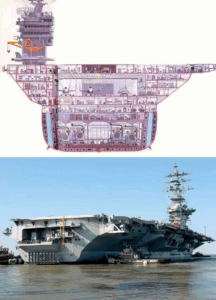
USS Enterprise now decommissioned and in its ‘breaking-up” process
What are the most important parts of an aircraft carrier? by Winai Porntipworawech via LinkedIn.
An aircraft carrier is a large naval vessel designed for the launch, recovery, and support of aircraft operations at sea. These complex and sophisticated ships are composed of various critical parts and systems that work together to ensure operational effectiveness. Some of the most important components include:
- Flight Deck: The flight deck is the expansive, flat surface at the top of the carrier where aircraft take off and land. Constructed from reinforced materials, it features advanced arresting gear to safely stop landing aircraft that may approach too quickly.
- Hangar Deck: Located directly below the flight deck, the hangar deck is a spacious, enclosed area for storing and maintaining aircraft. This level is equipped with elevators that transport aircraft between the hangar and flight deck, facilitating efficient operations.
- Propulsion System: The propulsion system powers the aircraft carrier, allowing it to navigate through the water. It typically consists of large diesel engines or gas turbines, along with multiple propellers, providing the necessary speed and maneuverability.
- Defensive Systems: To protect against potential threats, aircraft carriers are equipped with a range of defensive systems. These include advanced radar systems for early threat detection, anti-aircraft missiles, and various types of guns for close-in defense.
- Accommodations: Serving as a floating city, an aircraft carrier must provide living and working spaces for its crew, which can number in the thousands. Accommodations include sleeping quarters, dining facilities, medical centers, and recreational areas, ensuring the well-being of personnel during long deployments.
Overall, the flight deck, hangar deck, propulsion system, defensive systems, and accommodations are crucial components of an aircraft carrier. Together, they enable the carrier to effectively launch and recover aircraft, defend itself against threats, and support the needs of its crew, making it a vital asset in naval operations.