Colin Storey Director and founder at 127 East Advisory : It’s crunch time for Australia’s defence sustainment budget.
In 2024, the Chief of Navy was reported by the ANAO as raising concerns with the adequacy of the defence sustainment budget. And the situation does not seem to have improved. Since 2018-19, the funding allocated to sustainment has increased by 48% (20% in real terms) but in many cases the capability it has delivered has dropped. The overall percentage of the defence budget allocated to sustainment has also fallen from 32.9% to 30.5% – something ASPI described as ‘buying a future force at a cost to the current one’.
But it might be worse than that. A recent ANAO report found that naval sustainment costs grew 5.8% a year between 2018 and 2022, while funding was indexed at only 2.5%. And with a force composed largely of ageing platforms and expensive new equipment, it is not hard to see this as a reasonable rate to extrapolate over the rest of the sustainment budget. Sustainment kept pace historically (6.7% a year to 2024-25), but the forward estimates slow to 4.4% a year to 2027-28 – well under that rate. When we look into the data on availability days and flying hours captured in past government reports, we can trace the impacts of funding challenges on capability.*
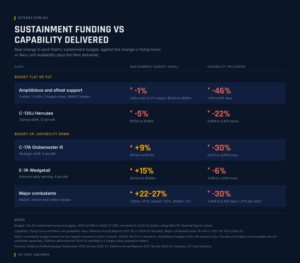
Sustainment funding versus capability delivered
Some key weapon systems have seen flat or reduced funding and a cut in delivered capability:
– Amphibious and afloat support ships (LHD budget flat, availability days down 46%)
– C-130J (budget down 5% in real terms, hours down 22%)
In other cases the budget rose, but capability delivered dropped:
– C-17 (budget up 9% in real terms, hours down 30%)
– E-7A (budget up 15% in real terms, hours down 6%)
– Major combatants (Collins up 27% and Hobart up 22% in real terms, availability days down 30%)
So the money we do spend is delivering less.
In this financial year, the Portfolio Budget Statement shows a drop in the sustainment budget – even as the forecast suggests Major Combatant availability days will increase by 24% and Amphibious and Afloat Support availability days will increase by 112% over the last reported actuals (2024-25) – a truly ‘courageous’ forecast, which assumes defects with LHD and Supply Class ships clear on time on a smaller budget!
What can we conclude from this data?
First, the defence sustainment budget is insufficient to deliver the capability Australia needs.
Second, a drop in the 26-27 sustainment budget is not going to help, regardless of heroic availability forecasts.
Third, Industry is going to continue to feel the budget squeeze in sustainment.
I can’t help but think that major changes in the way we support our Defence capability are needed to fix this. It is more than just a funding issue.
*Budgets: 2019-20 vs 2026-27 PBS sustainment products, real (CPI). Capability: 2017-18 vs 2024-25 Defence Annual Reports.