by Hector Donohue
Background
It is not well known that armed German raiders laid 230 moored mines in Southeast Australian waters in October/November 1940, resulting in four ships being sunk and one seriously disabled. The first US merchantman sunk in World War II, the cargo ship City of Rayville, was sunk off Cape Otway on 8 November 1940. Consequently, the RAN commenced render mine safe (RMS) training at Flinders Naval Depot in early 1940, with advice from HMS Vernon, the home of the Royal Navy’s RMS activity. Some 45 German GY moored mines were rendered safe around the Australian coast in 1941. RMS and Bomb and Mine Disposal (BMD) is now termed Explosive Ordnance Disposal – EOD – which will be used hereafter.
Some twelve German mines were washed ashore near Robe, in the Limestone Coast, the first mine arriving only seven months after it was laid. One of the mines near Robe was found by a fisherman on 12 July 1941 in Rivoli Bay. An EOD Party, comprising Lieutenant Commander Arthur Greening RAN, Able Seaman William Danswan, RAN and Able Seaman Thomas Todd, RANR, arrived from HMAS Torrens. Danswan was qualified in mine disposal and Todd had helped him render safe two mines and destroy another in recent weeks. Greening had been involved in the first mine rendered safe. Using the fishing boat’s dinghy the two sailors attached a line to the lifting eyes on the mine, and the fishing boat towed the mine ashore at Beachport on the northern tip of Rivoli Bay. On 14 July the mine was moved by sea further away from the town so it could be safely countermined. A demolition charge was placed on the mine and a cable run across a sand dune and a railway line to an electric exploder. After a misfire Todd and Danswan went back to replace the demolition charge. As they approached the mine it detonated killing both sailors as a result of the rising sea rolling the mine and breaking a horn. They are thought to be the first Australian casualties on Australian soil during this war.
EOD in the Pacific
In early 1942, after the Japanese entered the war, the RAN increased the tempo of RMS training at Flinders Naval Depot. The Australian Army also established a Bomb Disposal (BD) School at Bonegilla in northeast Victoria. Army bomb disposal units when formed, were allocated to Military Districts across Australia. The first Royal Australian Air Force Bomb Disposal course was held in April 1942, and several Bomb Disposal Squads were formed at Darwin, Townsville and Port Moresby.
RAN EOD personnel, some of whom trained at the Army BD School, were progressively deployed to vital ports and eventually in support of operations in the islands to the north of Australia, commencing in Milne Bay on the eastern tip of New Guinea in August 1942. The supreme commander of the South-West Pacific Area, General Douglas MacArthur, had chosen Milne Bay as a forward base from which to strike by air at the Japanese conquests in New Guinea and the islands to the north.
Broadly, each service was responsible for EOD within areas under its control, with the Navy being responsible for ordnance under water. In practice they worked closely together and the division of responsibility between the three services, during a combined or joint operation, was determined by the commander exercising unified command.
Whilst much has been written about the few RANVR officers who conducted EOD activities in UK and Europe during WWII, and the bravery and awards – including four GCs – is acknowledged, little has been written about the men who conducted EOD in the Pacific. In fact, Herman Gill’s official history of the RAN in World War II does not even mention them.
RMS operations by the RAN in the Pacific theatre were completely different to those undertaken by RANVR officers in UK who dealt with sophisticated German ground mines, lived in normal accommodation in cities, were driven to and from the mine site and were supported by a scientific community at Vernon who provided RMS advice. EOD in support of Allied offensives in the Pacific focused on unexploded Japanese ordnance and booby traps, while those involved lived in the field, often close to fierce fighting and relying on their own initiative and knowledge with no back up.
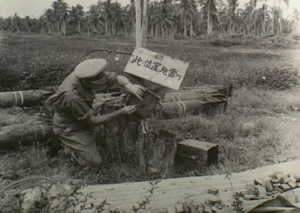
New Guinea, May 1944. RAN officer delouses a Japanese booby trap. The notice warned Japanese troops to avoid the booby trap. (AWM)
Whilst 10 RANVR officers contributed to RMS activities in UK, more than 30 EOD officers and a similar number of sailors deployed in the Pacific. There was a gradual increase in EOD billets, peaking from the middle of 1943 to the end of the war and then rapidly declined. Awards for EOD operations by the RAN in the Pacific were sparse, probably because the operators were administratively remote, and their activities went largely unreported. The most decorated officer was Lieutenant HL (Bill) Billman RANVR whose story typifies Pacific EOD activities.
Lieutenant Billman
Harold Leon (Bill) Billman had a relatively short war in the RAN of just three years, but as an explosive ordnance disposal officer he was regularly close to the front-line action. After nearly two and a half years in the Air Force he joined the Navy late 1942 and qualified in bomb disposal. He was quickly involved in the battles in New Guinea in 1943 and demonstrated his courage and skill under dangerous circumstances earning a Mention in Despatches. This continued in 1944/45 when he was attached to the US Navy in the Philippines where he was awarded a DSC. Bill was demobilised in December 1945. Given his demonstrated abilities and bravery, it is surprising his career has not received greater coverage.
Billman joined the RANVR as a Sub Lieutenant on 16 November 1942 and was assigned to the M (mining) specialisation which covered controlled mines and bomb and mine disposal. He completed a controlled mine course and render mine safe course at Flinders Naval Depot before qualifying in bomb disposal at the Army Bomb Disposal School at Inglefield in February 1943. Bill was then posted in March to HMAS Platypus at Cairns for bomb and mine disposal duties.
Between 1942 and 1945, Queensland became a support base for the war effort in the South West Pacific and the ports in Brisbane, Townsville and Cairns were rapidly expanded to become significant naval bases. Shipping congestion at Townsville caused the main naval presence in north Queensland to be based further north at Cairns. Early in 1943 RAN wartime facilities for the port of Cairns also included an oil tanker berth and the RAN shore depot, HMAS Kuranda, containing naval stores and accommodation for about 400 personnel. In February 1943 the depot ship HMAS Platypus took up permanent mooring near the shore depot and the naval base at Cairns was re-named Platypus until she departed in May 1944.
Both the RAN and the USN utilised Trinity Inlet in Cairns which became the principal naval base for repair, refuelling, victualling and maintenance of minor naval craft such as Australian corvettes, Fairmile patrol launches, and US motor torpedo (PT) boats. In addition, Consolidated PBY-5 Catalina flying boats of RAAF Nos. 11 and 20 Squadrons were based there from late 1942. The Cairns Billman found himself in early 1943 was a busy area but unlikely to have much requirement for explosive ordnance disposal.
He qualified Diver II in HMAS Penguin in May 1943 and was promoted to Lieutenant in June with seniority of 21 March 1943. In August 1943 he was sent to HMAS Basilisk at Port Moresby where he was engaged in EOD in the New Guinea forward areas.
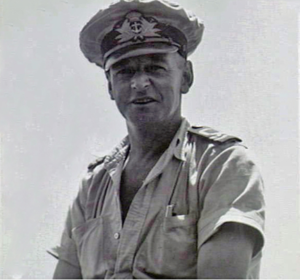
Lieutenant Harold Billman RANVR, New Guinea 1943. (AWM)
Deployment to New Guinea
The South West Pacific area was an Army theatre of war, but the US Army had few active bomb disposal squads in the theatre until after June 1944. Up till then bomb and mine disposal was handled by RAN EOD teams, Australian Air Force and Army bomb disposal units or US Navy Mobile Explosive Investigation Units. EOD personnel in support of Allied offensives in New Guinea and the islands were often close to fierce fighting and dealt with Japanese booby traps as well as the large amounts of unexploded ordnance both Japanese and Allied.
The campaign to take the Salamaua and Lae areas began after the successful defence of Wau in late January 1943, which was followed up by an Australian advance towards Mubo. A series of actions followed over the course of several months as the Australian 3rd Division advanced north-east towards Salamaua. The amphibious landing at Nassau Bay in July, some 24 km south of Salamaua, was carried out in order to capture a staging post to improve the supply situation for the main Australian force attacking Salamaua from inland bases.
Following the landing, the Australians were reinforced by a US regimental combat team, which subsequently advanced north up the coast. The US forces made contact with the Australian 17th Brigade around Mubo. The combined forces then turned their attention towards the Japanese at Salamaua, advancing slowly across difficult terrain during July and August, The Salamaua garrison was captured on 11 September 1943, while Lae fell shortly afterwards on 16 September, bringing the campaign to an end.
In August and September 1943, Billman was involved in providing EOD support for the Allied forces advancing towards Salamaua, following the Allied landings in Nassau Bay in July. He would have been attached to the advancing troops and regularly under fire. He was responsible for locating and disposing of land mines and booby traps left by the retreating Japanese which delayed operations and also caused casualties. The EOD teams would also demolish Japanese emplacements and tunnels.
A 3rd Division report describing the demands on the men fighting illustrates the difficult conditions Billman and other EOD personnel operated under. ‘It rained almost every day and campsites were damp, at best, or soaked. Such conditions of rain, mud, rottenness, stench, gloom, and, above all, the feeling of being shut in by everlasting jungle and ever ascending mountains, are sufficient to fray the strongest nerves. But add to them the tension of constant expectancy of death from behind the impenetrable screen of green, and nerves must be of the strongest, and morale of the highest, to live down these conditions, accept them as a matter of course, and maintain a cheerful yet fighting spirit.’
After joining HMAS Ladava at Milne Bay on 1 October, he was hospitalised in Port Moresby two weeks later with malaria and was posted to HMAS Moreton in Brisbane mid November for bomb and mine disposal duties.
Japan’s entry into the war in December 1941 saw south-east Queensland become an important strategic hub following an expansion of the Allied presence in the Brisbane area. A US submarine base was established at New Farm and additional naval stores depots, victualling yards and maintenance facilities were created. There was an increased throughput of personnel to serve in combined operations training camps situated at Toorbul and Bribie Island. An effective examination service, Port War Signal Station and mine watching service were also operated by the RAN, as was a small ships base situated at Colmslie. By 1944 Moreton was also responsible for administering operations, intelligence and communications staffs attached to Allied Headquarters, Allied Naval Headquarters and Naval Staff in depots throughout Queensland and New Guinea.
In May 1944, Billman was again hospitalised with malaria and in August a recommendation for a Mention in Despatches (MID) was forwarded to the Admiralty. For his time at the Nassau Bay area Billman was awarded a MID on 26 June 1945 ‘for courage, skill and undaunted devotion to duty in exceptionally hazardous operations.’ In September he was posted for duty with 7th Fleet. It is unlikely that there was much call for Bill’s EOD expertise whilst at Moreton apart from dealing with allied unexploded ordnance found during training, but his diving skills were regularly required. Indeed, he had to delay commencing his US Navy attachment to complete an important diving operation.
Attachment to the US Navy
Four US Navy Mobile Explosive Investigation Units (MEIU) were established during the war, two in the Pacific and two in the European theatre. MEIU 1 was established in July 1942 in the US for duty in the South West Pacific area and by January 1943 it had established its headquarters in Brisbane under Commander Service Force, Seventh Fleet.
MEIU 1 teams were also involved in the operations in New Guinea. During USN planning for the retaking of the Philippines a number of RAN officers with relevant expertise were attached to the 7th Fleet, including explosive ordnance disposal qualified officers.
Lieutenant Bill Billman was the first of three RAN officers to serve with MIEU 1, joining in Brisbane on 14 September 1944. During his first two weeks he attended a refresher course on US and Japanese ordnance and undertook trials in using shaped charges. At the end of September, he flew to Hollandia where the US Sixth Army was based and joined a US Underwater Demolition Team (UDT) under Lieutenant (jg) Colver USN onboard Landing Craft Infantry (Demolitions) 29 (LCI) which was attached to Commander 7th Fleet Amphibious Forces.
On Friday 13 October, the forces assigned for the operation comprising some 700 ships sailed from Hollandia for the 1,300 nm journey to Leyte. The invasion fleet was so large it took a day and a half to clear the harbour. LCI 29 was allocated to the Panaon Attack Group, TG78.3, which included the three Australian LSI’s: Manoora, Westralia and Kanimbla.
On 20 October, Billman (and the UDT) landed with the almost 3,000 men of the Sixth Army’s 21st Regimental Combat Team on the northern tip of Panaon Island just south of Leyte. The aim was to secure the strait between Leyte and Panaon Island to counter any IJN movement of ships onto Leyte Gulf. No enemy resistance was encountered, and a search of the island revealed the Japanese had left some months earlier. Investigations revealed that the channel between Panaon and Leyte had been laid with Japanese controlled mines but on leaving, the Japanese had destroyed the mines and removed the shore installations. Nothing else of interest was found and they returned to the LCI.
Three days later he landed with a support group that attacked a Japanese station at Leyte and captured some Japanese wireless equipment. The LCI then moved to the Tacloban area in Leyte, where the main landings had been conducted.
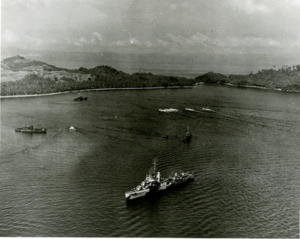
Landing at Panaon Island – the strait at the right separates Panaon from Leyte. (NWWIIM)
During an air raid he noticed that a bomb which had fallen on a troop laden liberty ship had not detonated. Billman boarded the ship and found the bomb lodged behind the bridge with a nose and tail fuse, both in an armed condition. He decided it was too dangerous to move, cleared the area of troops and with a heavy sea running, rendered the bomb safe, after which it was lowered over the side. On 28 October, Billman took a UDT detachment to the Tacloban airfield and cleared the airfield and its vicinity disposing of 24 Japanese and US unexploded bombs. Speed was essential and the task was completed in two days. Later he disarmed a US torpedo in a crashed aircraft near the airfield.
On 1 November Billman contacted a MEIU 1 field unit at the airfield and joined them in reclaiming Japanese fuse dumps for shipment. He remained onboard LCI (D) 29 and responded as required for bomb disposal tasks around Tacloban. In early December, whilst taking passage in LCI (D) 29 for the Luzon campaign he was involved in searching for K-2 mines in Billiran Strait.
On 2 January 1945 together with the UDT, Billman joined the destroyer USS Sands (APD13) as part of the convoy transiting for the Lingayen Gulf landings. He suffered a severe bout of malaria and was hospitalised onboard. On 11 January Sands received a report that Japanese suicide swimmers were operating in the Gulf. The ship proceeded to the area, and despite his malaria issues, Billman joined Colver to search for swimmers in the ship’s landing craft, locating and killing three. From these three and a further seven already dead, they recovered diaries which provided valuable intelligence. They assumed the 10 personnel were survivors of an attack group formed the previous night. Searches continued each night for the next week with negative results. Sands returned to Tacloban and the UDT transferred back to LCI (D) 29. Billman remained onboard until the end of January, recovering from malaria.
In mid-February, under orders from the Commanding Officer MEIU 1, Billman, together with Lieutenant (jg) Van Arsdale from MEIU, joined Seventh Fleet Intelligence Centre (SEFIC) personnel as the ordnance intelligence officer. They travelled to Paranaque, Manila Bay which was to be their base to examine Japanese hulks in the Bay. From 26 February until 9 March, they searched 19 hulks finding no ordnance of interest and no booby traps. In three of the ships Japanese escapees from the mainland were found and in one ship, nine escapees in a cabin refused to be taken prisoner and commenced committing suicide using their own grenades.
At the request of Commander 7th Fleet Amphibious Forces, Billman together with two MEIU officers were sent by PT boat to Corregidor Island on 13 March to examine Japanese Navy suicide boats, the first of such boats to be recovered. They spent three days examining, stripping and drawing the boats. The firing panel and wiring was recovered and sent to MEIU 1 for analysis and report. The boats were 6m long with a beam of 1.6m, had a speed of 18 knots and carried an explosive charge in the bow of 270Kg. Whilst on the island, the team examined all the open tunnels and rendered safe many J-XVI mines.
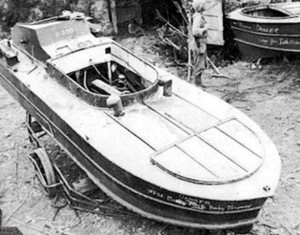
Shinyo Special Attack (Suicide) boat. (USN)
Billman then joined MEIU members searching Japanese dumps in the Nichols Field area, clearing mined areas and recovering ordnance of interest including Japanese torpedoes.
Acting on advice from a US Army bomb disposal officer who had been instructed to investigate a mine found on the beach at Cavite Naval Base, south of Manila, Billman and a MEIU officer went to assist. They found it was a new Japanese mine, which was subsequently designated ‘Camote’. Although of an unusual shape Billman found it had the standard safety switch and horns and, taking all precautions, rendered it safe. Subsequently a second one was found in a wrecked building at Sangley Point, which was also recovered. After lengthy searches in the ruins of a mine depot and surrounding areas, Billman found sufficient material which, with skill and perseverance, he was able to reconstruct a Camote mine. This was reported to Chief of Naval Operations (CNO) and the mine was shipped by air to the Mine Disposal School, Washington. The new mine was an aircraft laid moored mine, now designated Type 3 Mark 1 Mod 1, a 640Kg mine with an explosive charge of 80 Kg and four horns.
Other items of interest found in the burnt out base included sonar equipment and a new underwater sound making device. On his own initiative, Billman searched the burnt-out Japanese workshops and found sufficient parts of the sound making device to construct a complete unit. His report resulted in the CNO requesting the device be sent by air to Washington for study by the Bureau of Ordnance,
Billman spent the remaining weeks of his tour writing reports and gathering a range of Japanese underwater and air delivered ordnance, many of which he had collected himself, to be shipped back to Australia. In commenting on the material to be shipped, Billman made the point that he was fortunate to be able to draw on the MEIU 1 resources which enabled a significant amount of enemy ordnance to be collected, which would benefit bomb and mine disposal training in Australia. He completed his tour with MEIU 1 on 26 April and accompanied the collected Japanese ordnance by ship back to Australia.
Principally for his work at Cavite, Billman received a Commander Seventh Fleet Commendation in June that stated: ‘During the period September 1944 to April 1945 you were attached to MEIU 1 and rendered invaluable assistance in clearing unexploded ordnance from the Leyte and Manila Bay areas. By your diligent methods and careful research you recovered and reconstructed a new type of Japanese mine and a new enemy underwater sound making device. The Commander Seventh Fleet commends you upon your exemplary performance and your contributions to the success of our operations in the Philippines.’
Lieutenant John Hunter RANVR joined MEIU 1 in November 1944 remaining until August 1945. He was initially employed in the Unit’s mine disposal vessel USS YP 421 and then continued bomb disposal activities in Cavite Naval Base. In reporting on the two RAN officers to Navy Office in April 1945, the Commanding Officer, Lieutenant Commander F M Rivinus Jr USNR stated ‘This command is pleased to have attached two officers of the quality of Billman and Hunter. They have co-operated in every way with this unit. They have worked unusually hard at their jobs and by doing so have earned the respect and friendship of every officer in the unit’.
Lieutenant Gavin Anderson RANVR, the third RAN officer, joined MEIU 1 in July remaining until November 1945.
Final Posting and Post War
Billman returned to HMAS Cerberus where he was involved in RMS training in the Torpedo School. His DSC was promulgated in the London Gazette on 6 November 1945 with the following citation: ‘Lieutenant Billman landed on Panaon Island on 20thOctober, 1944 with the assault forces. He displayed bravery, devotion to duty and exceptional skill over a period of four months in dealing with Japanese mines and unexploded bombs in the clearance operations in the Philippines’.
At Cerberus, Billman did not get on well with the OIC of the Torpedo School, Lieutenant Commander RH Fanshawe RN who in his reporting of Billman was less than complementary. He wrote that Billman was a good EOD officer for operations but had very little administrative ability and was not outstanding in any way. He also did not recommend him for promotion. In fact, Billman had exhibited outstanding administrative qualities in collecting and arranging for transport to Cerberus of the many Japanese ordnance artefacts, for which Fanshawe seemingly gave no credit. After a ‘full on’ operational period with the US Navy, it must have been hard to adjust to life in a training establishment working for a RN officer with little understanding of US procedures and who was not qualified in EOD. This clash of personalities in his final posting after receiving such a high award, together with his malaria attacks, may well have soured his feelings towards the navy. Billman had a final medical Board on 23 November, demobilised on 17 December 1945 and moved to live with friends in West Footscray.
Billman’s DSC was despatched from London and arrived in Navy Office, Melbourne in May 1946. Billman would have been contacted regarding a presentation but must have refused as the medal was sent by registered post to him on 18 November 1946.
Billman was approached by the RAN in October 1950 to assist with the War Crimes Trials at Manus Island (One Lieutenant Commander and two Lieutenants were allocated to the War Crimes Compound at Manus Island from early 1950 until November 1951.). He applied to rejoin the RAN in October 1950 but although recommended, he was assessed as medically unfit and his re-entry was not approved.
H.L. Billman DSC died in Wangaratta on 16 April 1968, just 60 years old. His body was taken to the Melbourne Crematorium, Fawkner, and his remains were interned in the Victoria Garden of Remembrance, Springvale Botanical Cemetery in Melbourne, which honours those who died as the result of service in the armed forces of the Commonwealth. It has been Australian policy since 1922 to extend official commemoration to eligible post-war deaths, and in Billman’s case would indicate his death was determined by the Department of Veterans Affairs to have been related to war service.
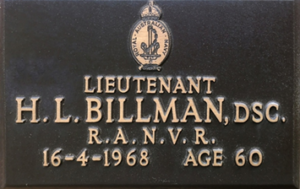
Plaque at Victorian Garden of Remembrance, Springvale (Author)
.