A newly approved US support package for the SSN-AUKUS program has effectively confirmed that the RN and Royal Australian Navy’s next-generation attack submarines will be equipped with vertical launch cells.
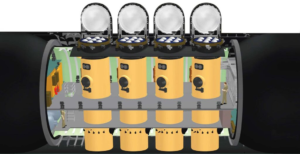
Virginia Payload Module (Image: GDEB) The Virginia Payload Modules are being incorporated in the US Navy’s Block V Virginia-class boats by inserting an extra compartment amidships. The VPM is accessible from within the pressure hull, allowing maintenance of larger payloads while alongside.
The detail, contained within a US Foreign Military Sales (FMS) notification, provides one of the clearest indications yet of how the future boats will be armed. The notification outlines a wide-ranging UK request for technical assistance, equipment and embedded personnel to support submarine combat system development. Among the most significant elements is support for “AUKUS-specific vertical deployment tubes” and “common weapon launchers”, pointing directly to the integration of vertical launch cells into the design.
The likely adoption of the US Navy’s Virginia Payload Module (VPM), or a close derivative, signals a significant enhancement in strike potential. The VPM consists of large-diameter vertical tubes, each containing seven cells capable of accommodating strike-length weapons. These tubes can house cruise or hypersonic missiles, as well as alternative payloads such as medium-sized uncrewed underwater vehicles (UUVs) or seabed sensors.
Vertical launch capability allows payloads larger than the 21-inch diameter limit imposed by torpedo tubes, greatly expanding future options. This is particularly relevant as both the RN and Royal Australian Navy seek long-range strike weapons able to penetrate anti-access and area denial environments. The ability to deliver such effects covertly from submarines provides a powerful conventional deterrent against peer adversaries.
The US Navy has already moved in this direction, converting four former ballistic missile submarines into SSGNs equipped with large numbers of vertical launch cells. As these boats retire, their firepower is being partially replaced through the introduction of Virginia Payload Tubes (VPT) in earlier Virginia-class boats and the larger VPM in Block V submarines.
The additional hull section to house VLS partly explains the increased size, complexity and cost of SSN-AUKUS. Theoretically, VPM tubes can be adapted as a diver lock-out chamber, supporting special forces operations. It is unclear for now how many modules will be fitted to SSN-AUKUS, but the number is likely to be a balance between cost and desired strike capacity.
Commonality also has strategic advantages. Australia, already heavily reliant on US weapons, would benefit from shared logistics and stockpiles at bases such as Guam or Perth. For the UK, compatibility with US launch systems could also support integration of future weapons, including a submarine-launched variant of the Stratus missile (Future Cruise and Anti-Ship Weapon) being jointly developed with France.
The broader FMS package also includes a “submarine warfare federated tactical system”, supported by advanced computing infrastructure, simulation tools and embedded US and UK personnel. As previously covered, the General Dynamics AN/BYG-1 submarine combat control system is expected to be the core control element for SSN-AUKUS, although freedom to integrate predominantly European sensors and weapons will be retained. AN/BYG-1 is an open-architecture system already in service with the US Navy’s SSNs and the Royal Australian Navy’s Collins class SSKs.